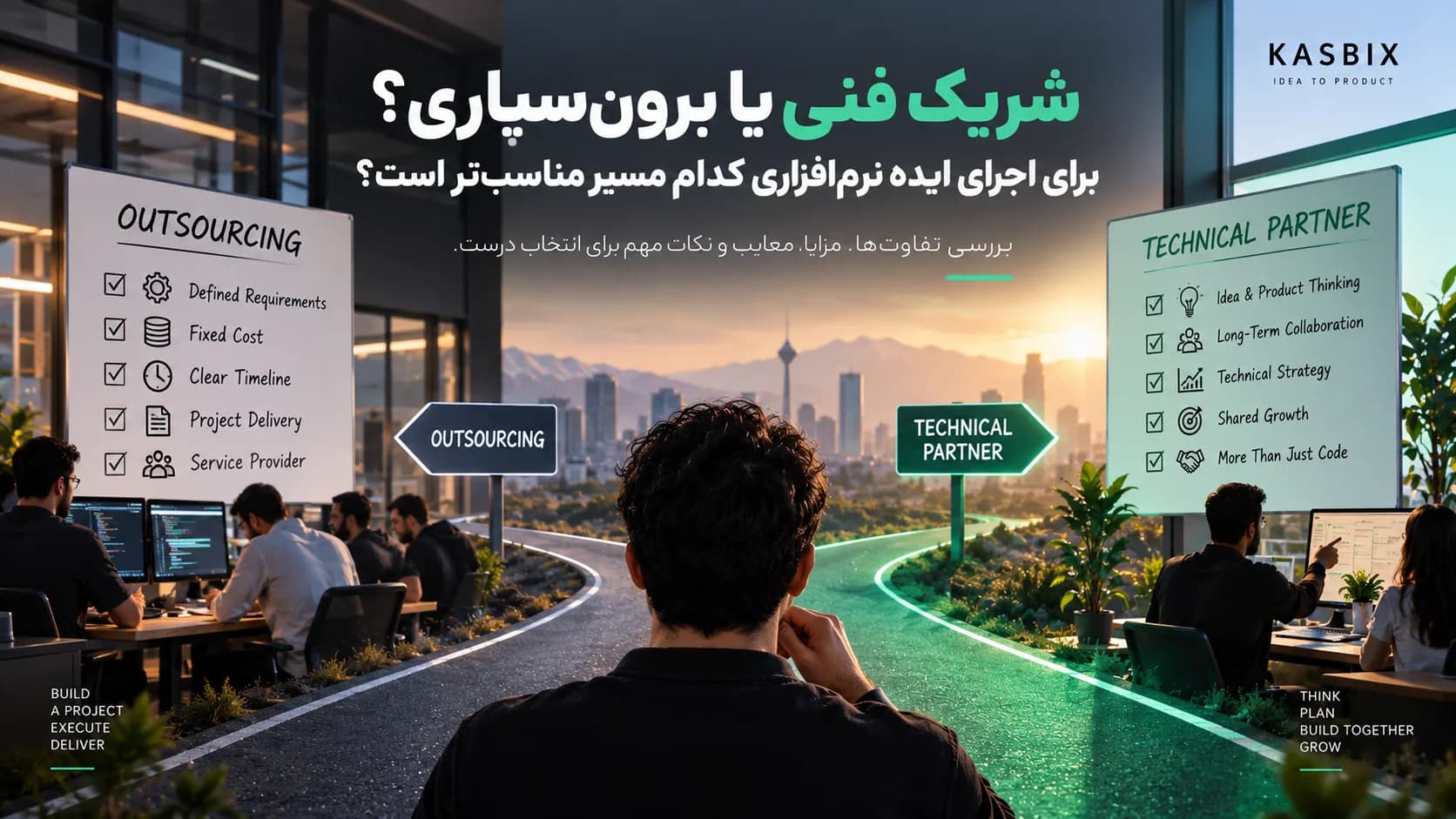
Technical Partner or Outsourcing? Choosing the Right Path for Your Software Idea
By Kasbix
Building the product is only part of the decision
You have an idea for a software product. Maybe it is a mobile application, a SaaS platform, an AI-powered service or a system designed for a specific industry.
Sooner or later, one important question appears: Who is going to build it?
For founders without an internal technical team, two common options are outsourcing development or finding a technical partner. They may look similar at first, but they represent two very different relationships.
What does outsourcing mean?
In a traditional outsourcing model, you hire a freelancer, agency or software company to deliver a defined project.
You explain the requirements, the development team estimates the scope, cost and timeline, and the product is developed based on an agreed contract.
This model works particularly well when you already understand what needs to be built, have sufficient budget and want to maintain full ownership and control of the business.
What is a technical partner?
A technical partner is usually involved beyond writing code. Depending on the partnership model, they may participate in product decisions, technical strategy, architecture, development and sometimes even the long-term direction of the business.
Instead of thinking only about how to implement a requested feature, a good technical partner may question whether that feature should exist in the first place.
This makes the relationship closer to building the product together rather than simply purchasing development services.
1. Consider how clearly defined your product is
If you already have validated requirements, detailed workflows and a clear product roadmap, outsourcing can be an efficient option.
But early-stage ideas often contain many assumptions. The target market may change, features may need to be removed and the initial business model may evolve after speaking with users.
In these situations, having technical expertise involved in product decisions can become significantly more valuable.
2. Think about the responsibilities you want to share
When you outsource development, product and business decisions generally remain your responsibility. The development team is primarily responsible for delivering the agreed software.
A partnership can be different. Responsibilities may extend to technical planning, product strategy, prioritization and long-term development.
Before looking for a partner, ask yourself whether you actually want someone involved in these decisions or simply need a professional team to execute your plan.
3. Budget is not the only difference
Founders sometimes assume that finding a technical partner is simply a way to build software without paying development costs. That is a dangerous assumption.
A real partnership means exchanging value. If a technical team contributes significant time, expertise and resources, it will usually expect meaningful value in return, such as equity, revenue sharing or another agreed structure.
Partnership should therefore be evaluated as a long-term business relationship, not as free development.
4. Evaluate the commitment required from both sides
A software project may last several months. A successful startup relationship can last many years.
This means choosing a technical partner requires more than evaluating programming skills. Communication, expectations, decision-making processes, responsibilities and long-term objectives all matter.
A technically excellent team can still be the wrong partner if both sides have fundamentally different expectations.
5. Ask what happens after the MVP
Launching the first version is rarely the end of a software product.
Users provide feedback. Bugs appear. Infrastructure needs to scale. New features are requested. Analytics reveal unexpected behavior and sometimes the entire product direction changes.
Before choosing either model, determine who will maintain and develop the product after launch.
When does outsourcing make more sense?
Outsourcing can be a strong choice when the project scope is reasonably clear, funding is available, you want full ownership of the company and you mainly need an experienced team to design and develop the product.
It can also provide clearer boundaries around budget, deliverables and responsibilities.
When can a technical partnership make sense?
A technical partnership may be worth exploring when technology is central to the business, the product requires continuous technical development and the founder brings meaningful complementary value such as industry expertise, distribution, customers, capital or access to a specific market.
The strongest partnerships are usually created when both sides contribute something difficult for the other side to replace.
Not every good idea is a good partnership opportunity
An interesting idea alone is rarely enough to justify a partnership.
A technical team evaluating a partnership may also consider the market, founder experience, customer access, business model, competition, execution capability and evidence that the problem actually exists.
This is why validating an idea before searching for a technical partner can make the conversation much more meaningful.
How Kasbix approaches this decision
At Kasbix, software ideas do not necessarily follow a single path.
Some businesses already know what they need and are looking for an experienced team to implement their product. Others have an early-stage idea that requires technical and product evaluation before development begins.
And in selected situations, an idea may have the ingredients for a deeper partnership.
The important part is choosing the right relationship for the project instead of forcing every idea into the same development model.
Before asking who should build your idea, first determine what kind of relationship your idea actually needs.
Comments (0)
No comments yet. Be the first to share your thoughts.
Leave a comment
Comments are reviewed before appearing on the site.